Monday, February 24, 2014

Announcing the 2014 Institute for Genetic Genealogy Conference


The Institute for Genetic Genealogy is pleased to announce the 2014 International Genetic Genealogy Conference, which will be held August 15-17 in Washington, DC at the National 4-H Conference Center. This conference has been planned in order to address the great need for genetic genealogy education.

An outstanding group of genetic genealogists and population geneticists have agreed to speak at the conference, including representatives from all of the major genetic genealogy companies. Dr. Spencer Wells, who heads the National Geographic Genographic Project, will be the keynote speaker. 


The main portion of the conference will be held on August 16 and 17 with a packed schedule of presentations from morning until night for those who want to learn as much as possible during this unique opportunity. Saturday will run from 8:30 am until 9:15 pm and Sunday from 8:30 am to 5:30 pm. Additionally, Family Tree DNA will hold a workshop in the evening of August 15. (Other genetic genealogy companies have also been offered the opportunity to present workshops on August 15 during the afternoon.) 


More details about the conference and registration information can be found at the website. The registration fee for the conference is $85 and will be limited to 800 total attendees. Meals and lodging will be available at the conference center but must be purchased at least one month in advance. The preliminary conference schedule can be found here and descriptions of the presentations and biographical background about the speakers can be found here.

Tim Janzen (with the assistance of his wife Rachel Janzen) and I have been planning and making preparations for this conference for the past six months. Angie Bush, Charmaine Riley Holley and Paul Woodbury have also provided valuable assistance, including distributing conference flyers at RootsTech and running the Institute for Genetic Genealogy's booth there. 
 

We are grateful to all of the speakers who are willing to share their knowledge with the genetic genealogy community. A complete list of the speakers and their presentations is as follows:

1.  Ancestry.com representative - Ancestry.com DNA products

2.  Jim Bartlett - Getting the Most of Your Autosomal DNA Matches and Triangulation, an Essential Tool to Sort out Your Matches and Map Your DNA

3.  Terry Barton - Surname Project Administration

4.  Dr. Blaine Bettinger - Using Free Third-party Tools to Analyze Your Autosomal DNA

5.  Angie Bush - DNA Case Studies

6.  Rebekah Canada - Mitochondrial DNA Haplogroup H

7.  Shannon Christmas - Identity by Descent: Using DNA to Extend the African-American Pedigree

8.  Karin Corbeil, Diane Harman-Hoog, and Rob Warthen - Not Just for Adoptees: Methods and Tools for Working with Autosomal DNA Results from the Team at DNAGedcom

9.  Family Tree DNA representative - FTDNA Products

10.  Dr. Maurice Gleeson - An Irish Approach to Autosomal DNA Matches

11.  Katherine Hope-Borges - ISOGG

12.  Bill Hurst - Mitochondrial DNA Focusing on Haplogroup K

13.  Dr. Tim Janzen - Using Chromosome Mapping to Help Trace Your Family Tree

14.  Dr. Kathy Johnston - From X Segments to Success Stories: The Use of the X Chromosome in Genetic Genealogy

15.  Thomas Krahn - I've Received my Y Chromosome Sequencing Results - What Now?

16.  Dr. Doug McDonald - Understanding Autosomal Biogeographical Ancestry Results

17.  23andMe representative - 23andMe Features

18.  CeCe Moore - The Four Types of DNA Used in Genetic Genealogy

19.  Dr.  Ken Nordtvedt - Y Haplogroup I — Very Early Europeans?

20.  Dr. Ugo Perego - Native American Ancestry Through DNA Analysis

21.  Dr. David Pike - The Use of Phasing in Genetic Genealogy

22.  Bonnie Schrack - Y chromosome Haplogroups A and B

23.  Larry Vick - Using Y-DNA to Reconstruct a Patrilineal Tree

24.  Debbie Parker Wayne - Mitochondrial DNA: Tools and Techniques for Genealogy

25.  Dr. Spencer Wells - the Genographic Project

26.  Dr. Jim Wilson - BritainsDNA's Chromo2 test and Y chromosome research


We hope to see you there for this wonderful educational opportunity!

Wednesday, February 19, 2014

BritainsDNA Chromo2 Y-SNP Results Spreadsheet

I received an email from Dr. Jim Wilson of BritainsDNA today which included a link to a spreadsheet with Chromo2 Y-SNP results. He has given me permission to publish it with his comments:

We have finally got round to releasing an anonymised dataset of ~2000 chromo2Y results. This is an excel sheet with ~14,200 SNP results for ~2000 random men using the chromo2 chip, so will be a goldmine for discovering further genealogical structure in European haplogroups. I think it will be of great interest to genetic genealogists and others who are interested in breaking down their haplogroups and subgroups. 

The link is:  
https://www.britainsdna.com/download/C2_2000_v2.zip
(Updated 2/24/14)

Thanks again, Jim!


Wednesday, January 8, 2014

Artificial Insemination Story Covered on Salt Lake City KUTV CBS Affiliate and University of Utah Releases a Statement

Coverage of the artificial insemination story (<< full story here) that I first wrote about yesterday is gaining steam. A segment just led the news on Salt Lake City's CBS Affiliate KUTV.  It included an audio interview with Pam Branum. (View here.) 

In conjunction with this coverage, the University of Utah released a statement. Here it is in its entirety:

"Since April 2013, the University of Utah has been investigating credible information regarding the possible mislabeling or tampering of a semen sample at RMTI (Reproductive Medical Technologies, Inc.), a private andrology lab owned by a University faculty member (now deceased). The facility was a private laboratory located in Midvale, Utah. While not owned or operated by the University, the University contracted with RMTI for specimen preparation and semen analysis. Additionally, RMTI prepared semen samples for private physician offices throughout the community, not University physicians.

Through genetic testing, a woman who received artificial insemination (AI) in 1991 discovered the biological father of her child was not her husband, as she had assumed. She traced the genetics of her child to a man who was a former employee of the now-defunct RMTI, which may have prepared the AI sample. The man in question was also a part-time employee of the University from 1988-94.

There are no remaining records from RMTI to prove the claim and the man in question has been deceased since 1999. Consequently, it is unknown how this incident might have happened. In addition, there is no evidence to indicate this situation extends beyond the case in question. We understand this information has been upsetting for the family and other clients of RMTI. We want to help alleviate this distress by providing professional genetic testing for RMTI clients who were treated between 1988 through 1994.

Concerned individuals should contact the University of Utah Andrology Lab at 801-587-5852."


Although there are some discrepancies from my perspective, I believe that this statement is a good start. It is my understanding that Thomas Lippert worked at the clinic from 1986 through1997, so I'm not clear as to why they are only offering genetic testing to those who were clients between 1988 -1994.

This part of the statement is obviously concerning, "RMTI prepared semen samples for private physician offices throughout the community" because it seems to imply that others could potentially be affected by Tom's actions who were not direct clients of the RMTI clinic. 

From my perspective, independent genetic testing might be a better option since the DNA samples of Tom's relatives are already in the three major genealogy DNA databases (see sidebar for links). If the potentially affected families take the university up on its offer of genetic testing (I assume this would be traditional paternity testing) and they learn that the presumed father is not the biological father of their child, then they will need to undergo further testing to determine if Tom Lippert is the biological father. It may be preferable to endure the anticipation of one test instead of two under these stressful circumstances. Of course, the families will undoubtedly carefully consider this and decide what they feel is best. I just want everyone to be aware that there are affordable options. 

Business Insider also picked up the story

For anyone who believes that they may be affected and would like to be in touch with the Branums, please consult this site

Tuesday, January 7, 2014

Artificial Insemination Nightmare Revealed by DNA Test

As anyone familiar with my work is well aware, I am an outspoken advocate of direct-to-consumer genetic testing and strongly believe that power lies in the truth of discovery. However, because I have experience with so many cases where DNA testing has unexpectedly uncovered complex family relationships, I always caution those who decide to DNA test to expect unexpected surprises.

I have never seen a more fitting example of the saying “truth is stranger than fiction” than in the case that I am about to share with you. The family involved has asked that I publish their experience in the hope that others can be helped by it. Further, they wish to emphasize upfront that this is not intended as a negative DNA testing story and that they are thankful for the knowledge gained through their tests.
 

In October of 2012, I was contacted by a genealogist named Paula*. She told me that she and her daughter Ashley* had taken autosomal DNA tests at 23andMe and enjoyed it so much that they had encouraged Paula’s husband and Ashley’s father, Jeff* to test as well. Shockingly, when the results came back, he showed no genetic match to his daughter. (*Names have been withheld at this time for privacy. Update - the family has now publicly revealed their identities. They are Pam, John and Annie Branum.)

Paula explained to me that just over twenty years ago; she and her husband were having difficulty conceiving. Their OB/GYN referred them to a fertility clinic associated with the University of Utah in Salt Lake City. (They have since learned that the legal name of the clinic was Reproductive Medical Technologies, but at that time only knew it as the University's clinic.) Paula underwent artificial insemination with her husband’s sperm several times unsuccessfully and they were thrilled when she conceived on what they had decided would be their last try in mid-August of 1991. They have been blessed with their wonderful daughter, Ashley, for the ensuing 21 years. Paula proudly told me that Ashley excels at everything that she tries – music, dance and even physics - and that she had always expressed an inexplicable desire to learn Russian. Paula had sometimes pondered from whom Ashley had inherited her elegant, long fingers and musical talent, but assumed those traits had somehow skipped a generation or two in Jeff’s or her own family.
 

After this discovery the family decided to undergo traditional paternity testing and they were not surprised when the results confirmed 23andMe’s findings. Since they were desirous of knowledge about Ashley’s paternal biological heritage, I advised them to have her tested at the other two major genetic genealogy testing companies, Family Tree DNA and AncestryDNA, in order to search for close paternal relatives. What we all expected to eventually find was another family who had been clients at the same fertility clinic and had their sample accidentally switched with Jeff’s. Paula and Jeff wondered if Jeff might have a child out there somewhere being raised by Ashley’s biological father.
 

When Ashley’s results came back at AncestryDNA, Paula immediately noticed that Ashley had a predicted 2nd cousin who was not from Paula’s side of the family. Paula’s family has deep Southwestern United States roots and 23andMe’s Ancestry Composition clearly distinguished between her genetic contribution to Ashley’s genome and this unknown significantly Eastern European biological father. 

Ashley's ancestral makeup with Eastern European represented by green


Paula bravely told her story to Ashley’s new cousin via AncestryDNA’s messaging system and waited for a reply. It took about a month, but when the reply came, it was not what had been expected. Cheryl* told Paula that her first cousin, Thomas Ray Lippert (his real name), had lived in Salt Lake City and had mentioned to the family that he was a sperm donor. A sperm donor? That was a strange twist since Paula and Jeff had never requested donor sperm. Further discussion revealed that not only had Tom claimed that he was a sperm donor, but he had actually worked at the fertility clinic Paula and Jeff had used. 

When Cheryl shared her cousin’s name and photo with Paula, the memories came flooding back. Paula and Jeff had actually known Tom Lippert. He had worked at the front desk of the clinic and also as a tech in the back. Paula remembered him proudly displaying dozens of photos of babies behind his desk, boasting that he had helped all of their parents conceive. Looking at all of those beautiful babies and Tom’s confidence gave Paula hope that she and Jeff could have the baby that they so desperately wanted as well. She never could have imagined how far Tom apparently would go to “help” couples conceive. When Paula broke the news to Jeff and showed him Tom’s photo, he told her that he too remembered him and recalled thinking that Tom was a bit odd when he handed him the sample receptacle and the magazine.

Thomas Lippert as a young man


Cheryl told Paula that Tom was deceased and had been an only child, but that his mother was still living and offered to arrange for a DNA test to be done to confirm their suspicions. This test eventually confirmed that Tom was indeed Ashley’s biological father.

Tom's mother's DNA compared to Ashley's DNA, confirming the relationship


Heartbreakingly, Tom’s now 99-year-old mother was excited at the prospect of having a grandchild since Tom had never fathered any children other than the ones that he told his family had been conceived through his “donations”. He had even sent his mother a photo of a darling little boy that he claimed was his biological child, but he did not share the boy’s name or his whereabouts. (Updated 2018: Now located, photo removed by request.)

When Tom’s mother saw the photos of Ashley, her only known grandchild, Cheryl related “she hugged them to her chest with such joy.” Although Tom’s mother was innocent in all of this, understandably, Paula and her family were initially conflicted as to whether they wanted to get further involved with Tom’s family, but over the past year since this discovery they have proven to be extremely helpful and supportive. Cheryl has been a very good friend to the family and this has helped to ease the difficulty of the situation in which they have all found themselves.

Paula’s family still held out hope that it was all just a big mistake and that Tom had not intentionally substituted his sperm for Jeff’s, but what they discovered next made that possibility seem increasingly less likely.

In the second phone call with Paula, Cheryl revealed Tom’s troubled past. Expressing that she wanted to be completely upfront, she told Paula that Tom had served time in prison for kidnapping a female college student. Sickened by this knowledge, Paula searched the Internet for any additional information on him. She was shocked to find an article from People Magazine dated October 20, 1975. What she read was horrifying. The article stated that Tom had been a brilliant law student at Notre Dame Law School and had gone on to a promising early career as a law professor at Southwestern State College. However all that changed, when at 25, he was accused of hatching a bizarre plan to kidnap a young Purdue student and hold her as a prisoner in a “love experiment”. The student was reportedly kept in a black box and subjected to electro- shock therapy in an attempt to brainwash her into falling in love with Tom. After his arrest by the FBI, Tom hired the famed attorney F. Lee Bailey to defend him. Bailey negotiated a plea bargain for him and Tom pleaded guilty to two counts of conspiracy to kidnap and received a sentence of six years in prison, serving two. (See here and here for more information on the case.)

F. Lee Bailey with Thomas Lippert (purchased on eBay)

While Tom’s family disputes some of the charges due to the fact that the victim visited several of their homes and appeared not to be under duress, they concede that whatever the true circumstances, his actions were highly questionable.

The fact that Tom, a felon convicted of victimizing a young woman, was later hired by a clinic whose patients were vulnerable women desperate to conceive, is simply incomprehensible. Obviously, this was one of the last positions that Tom should have been permitted to hold. Paula discovered that after marrying his third wife and being released from prison, Tom had lived in Minnesota for a few years. He eventually moved to Salt Lake City, taking classes at BYU, and his first job was working in the Reproductive Technologies fertility clinic where he was employed for nine years from 1986-1995* (recently updated to 1986-1997 or 1998). This begs the question: Could he have fathered hundreds of children? Paula realized that those dozens of photos that Tom so proudly displayed behind his desk may have been his biological children. She wondered if she should tell Ashley this distressing news about her biological father. Following her deeply held convictions, she decided that Ashley must know the truth and that they must do everything in their power to alert the other families potentially affected by Tom’s actions.


Tom Lippert as he looked when he worked at the clinic

Paula and I have discussed the potential implications of this around the Salt Lake City area, where half-siblings may be unknowingly coming into contact with each other and developing romantic relationships. Since Tom claimed to his family that his sperm was also frozen and shipped to other states, families outside of Utah could be affected as well. This concern is the main reason that Paula and her family have made the unselfish decision to share their story publicly. She explained it to me with these words, “We've talked about losing our privacy when this first comes to light…If we keep this private we won't be able to say, ‘It's okay, we're going through this and we're stronger for it. You too, need to find out if you went to this clinic for this type of procedure (or any other where your husband's sperm was used) during these nine years. These possible half siblings may be attending the same colleges and developing relationships.’" She continued, “I also feel strongly that this can be stopped in the future from ever happening  again. Independent DNA testing [should be mandatory] after the baby is born when using any kind of sperm procedure. No one would do this knowing they would immediately be found out.”

I don’t think any of us can imagine the emotional upheaval this revelation must have caused the family or how violated they must have felt, but through it all they have remained upbeat and thankful for the gift that these unfortunate circumstances brought them - their beautiful daughter, Ashley.  She is an outstanding, well-adjusted young woman who has handled this shocking revelation about her origins with bravery and a positive attitude. This is a strong testament to the wonderful parents that raised her. Their family really is an incredible example of love triumphing over adversity.

It might surprise some to hear Paula’s thoughts on DNA testing and how it has affected her family’s lives. “We still believe wholeheartedly in DNA testing for genealogy,” she told me. “The three of us have said we are glad we now know and if we had it to do over, we would do 23andMe again.”  She also expressed to me how thankful she was with 23andMe’s quick response to her concerns. “They got back to me within 15-20 minutes of me first writing to them. I was in a panic and it was at the end of the day. It meant everything to hear back from them so quickly.” She is steadfast in her conviction that this is something that her family needed to know. She added, “My husband also said that he was glad to find out while he is alive. He wouldn’t want Ashley to ever think that if he had known the truth, maybe he wouldn’t have loved her. He had that opportunity and he made sure she knew he loves her just as much and to him it is insignificant. He is her father and always will be.”

So, you are probably wondering by now - what is the family’s recourse? Tom is in an early grave due to alcoholism (perhaps brought on by a guilty conscience?) and the clinic in question is no longer in business. When contacted and informed of Tom’s alleged treachery, the University of Utah claimed that he was, in fact, a “popular donor”. With his criminal background, this seems highly doubtful. When pressed for his donor number, they have been unable or unwilling to supply it to Paula, Ashley or even Tom’s widow, although all should be legally entitled to it if it indeed ever existed. Paula was reportedly told that they were unable to release it due to privacy concerns. However, when Tom’s widow requested it, which is her right as his next of kin, she was reportedly told that they did not have that information. (Sperm donor registries were searched under the name of the clinic and the university for any  donors fitting Tom's description - none were found.)  Further, the university has so far declined to contact the families who conceived at this clinic during the years that Tom worked there and advise them of the situation.

Both families, including Tom’s cousin and widow, support Paula in her efforts to get to the truth.  We believe that any other families affected would want to know as well. There is much more to this story – too much to share here today. The bottom line is that we are hoping that couples who used the Reproductive Medical Technologies Clinic in Salt Lake City (which they, like Paula, may have simply known as the University of Utah’s fertility clinic) to conceive between 1986 and 1995 will hear about this story and reach out to Paula. We have set up a site for inquiries (here). If couples suspect that they may have been one of Tom’s victims, they are encouraged to have their children tested at 23andMe where the DNA of both Ashley and Tom’s mother is in the database for comparison purposes. Testing at either of the other two companies – AncestryDNA or Family Tree DNA - will also match any half-siblings to Ashley’s DNA.

“I think about the families in SLC who will have this to deal with this, this year.  I want the truth for these families and then to move on with our lives. “ – Paula


We will keep everyone informed of any significant developments in this very important story.

Thursday, January 2, 2014

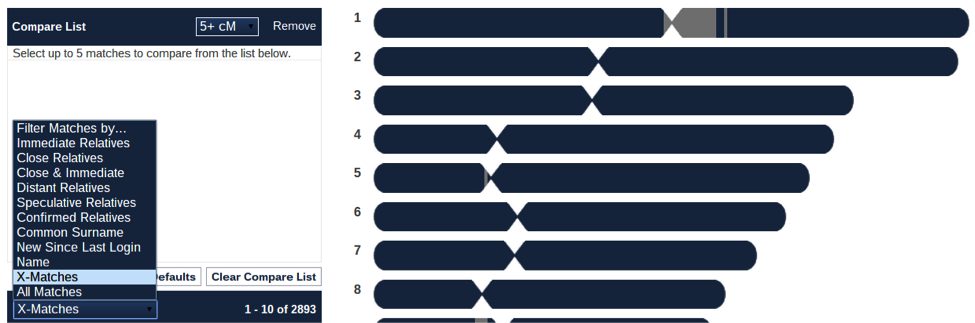
FTDNA Releases X-Chromosome Matching Data

Family Tree DNA has just released the X chromosome matching exactly as they promised at their conference in November. (Yay!)

On the match interface, it is noted that there is an X match, however to see the size of the segments, one must go to the Chromosome Browser. Currently, in the Download All Matches to Excel option in the Chromosome Browser, the X chromosome data appears as Chromosome 98.

Thank you, Family Tree DNA for the New Year's gift!


The following are the release notes directly from FTDNA:

This week’s big release is X-Chromosome matching. It has been fully integrated it into Family Finder matching.

Here is the menu link to the Family Finder Matches menu.


On the Family Finder Matches page, there is a filter to show only X-Matches.


When you use the X-Match filter on a male Family Finder kit, you should get only matches from the maternal X-Chromosome.


Next, like other Family Finder Matches you can expand the advanced bar for a match and click to add the match to the Compare in Chromosome Browser list.


Matches are added to the Compare in Chromosome Browser list. You could go right to the Chromosome Browser by clicking on the compare arrow at this point.


Next we can also go right to the Chromosome Browser.


Here are three immediate relatives. The first two share X-Chromosome DNA. The third (green) one does not.


When we scroll down to the X at the bottom, we see that X-Matching is displayed for the first two but not the third.


Moving to the Advance Matching page, X-Chromosome matches have also been integrated.


Tuesday, December 10, 2013

Family Tree DNA's Latest Updates


Family Tree DNA made many genetic genealogists very happy with their updates last week. I wasn't expecting to see anything new from them for at least two weeks, but they are already releasing another update today. I am extremely encouraged by the wonderful progress that Family Tree DNA is making toward giving its customers exactly what they have been asking for. With these wonderful improvements, they are demonstrating that they really are listening to what we want and need. Thanks again, FTDNA!

These changes are scheduled to go live today.

Rebekah Canada tells us:

Weekly Information Technology/Engineering Update (10 Dec 2013)

Matches Maps Locations Clear Button

Some users have requested the ability to clear their stored map coordinates for their most distant known maternal or paternal ancestors. We have added a Remove Location button to Step 3 of the Update Most Distant Ancestor’s Location wizard.


Family Tree DNA myFTDNA BETA Family Finder – Matrix

Today, we are happy to release our new BETA Family Finder – Matrix page. The Matrix tool can tell you if two or more of your matches match each other. This is most useful when you discover matches with wholly or partly overlapping DNA segments on the Family Finder - Chromosome Browser page. 

Due to privacy concerns, the suggested relationship of your two matches (if related) is not revealed. However, we can tell you whether they are related according to our Family Finder program. To use it, you select up to 10 names from the Match list on the left side of the page and add them to the Selected Matches list on the right side of the page. A grid will populate below the lists. It will indicate whether there is a match (a blue check mark) or there is not a match (an empty white tile).
 
You access the BETA Family Finder – Matrix page through the Family Finder menu in your myFTDNA account.


The page starts out with two list areas: Matches and Selected Matches. You add Matches to the Selected Matches list by clicking on a name and then on the Add button.


Here is a screenshot of the BETA Family Finder – Matches page with a few matches added to the Selected Matches list. 


Saturday, December 7, 2013

23andMe Releases a Sample of Their New V4 File: First Look and Analysis

23andMe has released access to a sample file of their new v4 chip. This is a 100% custom chip with hand-selected SNPs. In a departure from the other two companies offering autosomal DNA testing to the genealogy community, they are now using the Illumina iSelect chip as the foundation instead of the Illumina OmniExpress chip. On the new v4 chip, the total number of autosomal DNA and X DNA SNPs has decreased substantially, while the total number of mtDNA SNP and Y-SNPs has increased.

Since I heard about this new chip, I have been concerned about the impact it will have on the genetic genealogy community and, particularly, on the compatibility with 3rd party uploads and tools. If 23andMe customers are unable to take advantage of the extremely beneficial opportunity to upload their data into Family Tree DNA's Family Finder database and to make use of the wonderful tools at GEDmatch, that would be a huge loss for all of us. It would also be a shame if the usefulness of the Y-SNPs and mtDNA SNPs tested by 23andMe is reduced for our community. To try to determine if this will be the case, Dr. Tim Janzen has helped me to analyze the new file overall and Larry Vick has specifically analyzed the Y-SNPs.

The v4 chip currently has just over 602,000 total SNPs versus 967,000 total SNPs on the v3 chip. This chip is not as robust as the chip previously used by 23andMe or the chips used by Family Tree DNA and AncestryDNA for the autosomal and X-SNPs.This is of great concern, but 23andMe has stated that they plan to impute a large number of SNP allele values from our results (see comments at http://blog.23andme.com/news/23andmes-new-custom-chip/), so hopefully Family Tree DNA and citizen scientists will be able to do the same to extract the most utility and compatibility from this platform. I am continually surprised and amazed by the resourcefulness of our community, so I am hopefully optimistic.

This change in platforms was intended to help the company ramp up their processing capacity in conjunction with their massive marketing campaign to acquire one million customers and beyond.  (They can run 24 samples on each v4 chip at once instead of 8 on each of the v3 chips.) Especially in light of 23andMe's recent decision to provide ancestry-related interpretation and raw data exclusively, the v4 chip does not appear to be a beneficial development. In fact, it may result in additional loss of sales. Currently, the genetic genealogy and the DNAAdoption communities generally recommend first testing at 23andMe and then transferring the raw data into FTDNA's Family Finder database in order to be in two databases at a reduced price. If it turns out that FTDNA is unable to continue to accept 23andMe transfers, these recommendations will likely change. Loss of compatibility with Gedmatch would also have a very detrimental effect on the utility for those using the data for genealogical and admixture research.

The following analysis is in depth and intended for those who want the specific details of the changes. Instructions to download the v4 file will follow the analysis.
 
First let's look at the Y-SNPs.

Larry Vick tells us:
I compared my Y-SNP file I downloaded on 14 Aug 2012 to the Y-SNP file I downloaded today to see if my current file has any changes. There weren't any.  I then compared the (v4) file for Greg MENDEL that I downloaded today to a v3 file I downloaded for a friend (CRL) on 21 Mar 2013.

There are 2,329 Y-SNPs in the Greg MENDEL v4 file. CRL had 1,766 Y-SNPs in his v3 file. So the v4 file has 562 more SNPs than CRL's v3 file. Looking at the SNPs, there were 446 in CRL's v3 file that were not in the MENDEL v4 file. There were 1,009 in the MENDEL v4 file that weren't in the CRL v3 file. Of the 446 in the CRL v3 file that weren't in the MENDEL v4 file, 314 were no calls.

Of the 1,009 in the MENDEL v4 file that weren't in CRL's v3 file, 295 were no calls. When I compared the 1,009 in the MENDEL v4 file to my file I downloaded today, 494 were not in my file (although they could have been in past downloads but were removed prior to today's download). I have SNPs from v1, v2, and v3. Of the 515 that were in my file, 99 were no calls.

I compared the 494 that were not in my file to Adriano's file in the Y-Chromosome Comparison Project, and 268 were in his file. All but one of those 268 had i prefixes for the reference sequence number.

I then compared the 226 that weren't in Adriano's file to the ISOGG Y-SNP Compendium by position number (build 37), and 200 were in the ISOGG file. I created a list of those 200 with the first note field. The 26 that weren't in the ISOGG file included the one SNP with an rs number (rs5603911). The MENDEL file had 46 no calls for the 200 SNPs in the ISOGG file. All but one of the 226 that weren't in Adriano's file had i prefix reference sequence numbers.


Now let's look at the overall composition of the new v4 chip as compared to the other platforms.

Tim reviewed the v4 file and compared it to v2, v3, and FF files. The following are some general statistics on which he based his analysis.

atDNA SNPs
v2: 
561,846 atDNA SNPs in 23andMe v2 data in a 2009 download.
515 i atDNA SNPs in 23andMe v2 data in a 2009 download.
556,787 atDNA SNPs in 23andMe v2 data in a fresh download.
758 i atDNA SNPs in 23andMe v2 data in a fresh download.

v3:
930,381 atDNA SNPs in 23andMe v3 data in a fresh download.
7,455 i atDNA SNPs in 23andMe v3 data in a fresh download.

v4:
577,382 atDNA SNPs in 23andMe v4 data.
41,855 i atDNA SNPs in 23andMe v4 data.

Family Finder:
708,092 atDNA SNPs in Family Finder data in general, but a fresh download only had 707,269 SNPs in it.


Y-SNPs
v2:
1880 Y SNPs in 23andMe v2 data in a fresh download. Of these 213 are i SNPs.

v3:
1766 Y SNPs in 23andMe v3 data in a fresh download. Of these 232 are i SNPs.

v4:
2329 Y SNPs in 23andMe v4 data. Of these 526 are i SNPs.


X-SNPs
v2:
13,876 X SNPs in 23andMe v2 data in a 2009 download. Of these 19 are i SNPs.
13,828 X SNPs in 23andMe v2 data in a fresh download. Of these 96 are i SNPs.

v3:
26,007 X SNPs in 23andMe v3 data in a fresh download. Of these 1006 are i SNPs.

v4:
19,487 X SNPs in 23andMe v4 data in a fresh download. Of these 4227 are i SNPs.

Family Finder:
18,022 X SNPs in Family Finder build 37 data in a fresh download.


mtDNA
v2:
2019 mtDNA SNPs in 23andMe v2 data in a fresh download. Of these 1572 are i SNPs.

v3:
2459 mtDNA SNPs in 23andMe v3 data in a fresh download. Of these 2016 are i SNPs.

v4:
3154 mtDNA SNPs in 23andMe v4 data. Of these 2681 are i SNPs.


Here are his comparisons between the various platforms.

atDNA:
  • 453,854 atDNA SNPs in 23andMe v4 data are also found in 23andMe v2 data in a 2009 download. Of these SNPs, 419 are i SNPs. 
  • 453,357 atDNA SNPs in 23andMe v4 data that are also found in 23andMe v2 data in a fresh download. Of these SNPs, 546 are i SNPs. 
  • 509,630 atDNA SNPs in 23andMe v4 data that are also found in 23andMe v3 data in a fresh download. Of these SNPs, 6153 are i SNPs. 
  • 304,864 atDNA SNPs in 23andMe v4 data that have rs numbers are also found in Family Finder in a fresh download. 
  • I then checked the 41,855 i atDNA SNPs in 23andMe v4 data and checked for matching positions in the Family Finder data. I found that there were 2556 i atDNA SNPs in 23andMe v4 data that had matching positions in the Family Finder data.
  • Assuming that all of those matching positions correspond with the same SNP in the Family Finder data, there are a maximum of 307,420 atDNA SNPs in 23andMe v4 data that are also found in Family Finder in a fresh download. 

Y-SNPs:
  • 979 Y DNA SNPs in 23andMe v4 data that are also found in 23andMe v2 data in a fresh download. 
  • 1320 Y DNA SNPs in 23andMe v4 data that are also found in 23andMe v3 data in a fresh download.
  • This means that there are 1009 Y SNPs found on the v4 chip that aren’t found on the v3 chip
  • There are 563 more Y SNPs in v4 data than in v3 data. 

X-SNPs:
  • 11,070 X SNPs in 23andMe v4 data that are also found in 23andMe v2 data in a fresh download. 
  • 11,009 X SNPs in 23andMe v4 data that are also found in 23andMe v2 data in a 2009 download. 
  • 14,437 X SNPs in 23andMe v4 data that are also found in 23andMe v3 data in a fresh download. 
  • 7,513 X DNA SNPs in 23andMe v4 data that are also found in Family Finder in a fresh download.

mtDNA:
  • 1698 mtDNA SNPs in 23andMe v4 data that are also found in 23andMe v2 data in a fresh download. 
  • 2208 mtDNA SNPs in 23andMe v4 data that are also found in 23andMe v3 data in a fresh download. 
  • This means that there are 946 mtDNA SNPs found on the v4 chip that aren’t found on the v3 chip

Tim's preliminary conclusions
The fact that there are only 307,420 atDNA SNPs in 23andMe v4 data that are also found in Family Finder is highly concerning. The specificity of matches when comparing v4 data to FF or AncestryDNA data will be significantly reduced in projects such as my Mennonite autosomal project. At DNA SNP coverage for the overlapping SNPs between v4 data compared to FF or AncestryDNA data will only be about 44 SNPs per cM. I don’t know if FTDNA and GEDmatch will be able to allow imports of 23andMe v4 data. The fact that there are about 130,000 more atDNA SNPs in a Family Finder dataset than in v4 and the fact that v4 data won’t be readily uploadable to GEDmatch is forcing me to rethink 23andMe as my primary testing lab for distant relatives.


Third Parties and Download
My sincere hope is that Family Tree DNA and GEDmatch are able to adjust their systems to work with this new data from 23andMe. As soon as I hear anything, I will be sure and report it.

If you are interested in analyzing the file yourself and you have a 23andMe account, these are the directions for downloading the sample v4 file from 23andMe:

Enable the Mendel family in your account here:
https://www.23andme.com/user/edit/examples/

Then select Greg Mendel's raw data file from the drop-down list here:
https://www.23andme.com/you/download/

This file will probably still change slightly as they complete their validation process, but it should be pretty close to what we will start to see for new customers at 23andMe in the coming weeks.

Please let me know what you think. I am especially interested to hear analysis from the citizen scientists and the creators of our community's third party features.